

News & Updates
Cross-Border Medical Appointment Transfers: How to Plan a Same-Day Trip to Shenzhen or Guangzhou Hospitals


A follow-up appointment across the border is different from a one-off trip. It happens again and again, on dates that are largely fixed, and the timetable is set by the hospital rather than by the traveller. Blood tests have to be done in the morning fasting window, results take time, the consultation itself lasts only a short slot, and collection of medication plus booking the next appointment means another queue. Put those steps together and the day runs from early morning to late afternoon.
For elderly passengers, transport is usually the most tiring part. Changing vehicles several times, walking a long way to a pick-up point, and waiting outdoors all take their toll, and they affect how well a patient can communicate with the doctor that day. The notes below cover how a cross-border follow-up day is actually paced, how border crossings and hospitals match up, and how a pre-arranged transfer can fit around the appointment.
Figure 1. At the hospital drop-off area: a driver assisting an elderly passenger, where a follow-up transfer begins.
A clinic day is really several time windows
The first window is blood tests and examinations. Most tests require fasting, and hospitals concentrate blood-taking in the morning; miss that slot and the test has to be rebooked for another day. The departure time therefore has to be worked out backwards, from the closing time of the blood-taking counter, minus border clearance and driving time.
The second window is waiting for results. Between the blood test and the report, two or three hours can pass. Staying inside the hospital may not be comfortable, yet leaving risks missing the queue number being called. A transfer can be arranged around this: the driver waits outside the hospital, or returns at an agreed time, so the family can decide whether to rest indoors or sit down somewhere for a meal.
The third window is the consultation, payment and medication. Seeing the doctor usually takes ten to twenty minutes, followed by payment, collecting medicine and booking the next appointment. This is where plans slip, because what looks like the end often means another half hour of waiting, so the return journey needs a buffer.
The fourth window is the journey home. Border crossings are busy after four in the afternoon, and noticeably busier on the eve of a public holiday. If the patient is already tired, a door-to-door transfer is far more practical than changing vehicles again.
Matching the border crossing with the hospital
Shenzhen's hospitals cluster in Futian, Luohu and Bao'an, so the choice of crossing directly affects driving time. The University of Hong Kong-Shenzhen Hospital sits on Haiyuan 1st Road in Futian, near OCT Harbour; from the Shenzhen Bay Port the drive is about ten to fifteen minutes, and it can also be reached on foot from Shenzhen Bay Park station on Metro Line 9. Hospitals in Futian and Luohu are more conveniently reached via the Futian or Luohu crossings, while hospitals in Bao'an are further from the city centre and better served by the Shenzhen Bay or the new Huanggang crossing.
The new Huanggang crossing is now open, adding an option for journeys into Futian. Because it has only recently opened, connecting routes and passenger flows are still settling, so it is worth confirming the day's arrangements before setting out.
Guangzhou's hospitals are mostly in Yuexiu, Liwan and Panyu. The drive from Hong Kong takes about two hours or more, which makes a same-day return feasible only if the appointment is scheduled for the morning or around midday, otherwise the return leg runs late.
| Hospital | District | Most convenient crossing | Indicative drive time (traffic dependent) |
| University of Hong Kong-Shenzhen Hospital | Futian (near OCT Harbour) | Shenzhen Bay Port | About 10 to 15 minutes |
| Shenzhen People's Hospital | Lo Wu | Luohu Port, Liantang Port | About 15 to 25 minutes |
| Peking University Shenzhen Hospital | Futian (Lianhuashan area) | Futian Port, new Huanggang crossing | About 20 to 30 minutes |
| Southern University of Science and Technology Hospital | Bao'an | Shenzhen Bay Port, new Huanggang crossing | About 30 to 45 minutes |
| First Affiliated Hospital of Sun Yat-sen University | Yuexiu, Guangzhou | Shenzhen Bay or the new Huanggang crossing, then on to Guangzhou | About 2 hours or more |
| Guangdong Provincial Hospital of Chinese Medicine (Dade Road) | Liwan, Guangzhou | Shenzhen Bay or the new Huanggang crossing, then on to Guangzhou | About 2 hours or more |
| Guangdong Clifford Hospital | Panyu, Guangzhou | Shenzhen Bay Port, then on to Guangzhou | About 2 hours or more |
The questions elderly and less-mobile passengers ask most
Where does the driver wait during the appointment?Waiting can be arranged on a daily basis, with the driver on standby outside the hospital and returning to the drop-off area when needed. If you intend to return to Hong Kong and come back the same day, please say so in advance, because both the schedule and the border crossing will change.
Can a wheelchair or walking frame be carried?A folding wheelchair or walking frame normally fits in the boot. For a non-folding wheelchair, or where more space is needed to get in and out, a roomier vehicle is advisable; mention this when booking so that a suitable vehicle and a convenient pick-up position can be arranged.
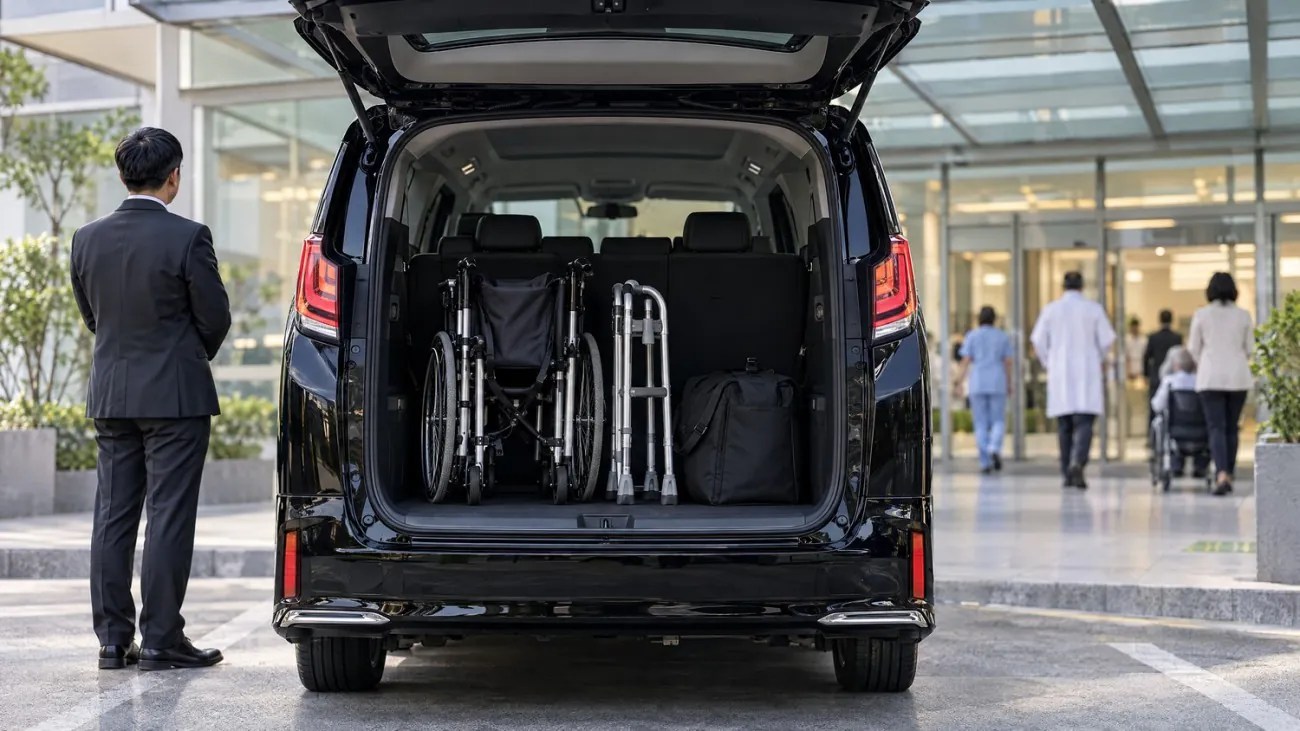
Figure 2. A folding wheelchair and walking frame in the boot: the space needed and the way a passenger gets in and out should be agreed when booking.
Can we be dropped off at the main entrance?Most hospitals have a drop-off area, and passengers with reduced mobility can ask to be set down close to the entrance. Some hospitals limit how long vehicles may wait during busy periods, and the driver will adjust according to on-site arrangements.
What if several people are travelling together?A typical follow-up group is an elderly patient with one or two family members, sometimes with a carer as well. For three to six passengers, a Toyota Alphard offers the more comfortable space; for two or three passengers who value privacy or a more formal reception, a Mercedes-Benz V-Class is the better fit.
Can we stop at a pharmacy or supermarket on the way?Yes, but mention the stop and the approximate time when booking, so that the schedule and waiting time can be calculated together.
Costs and subsidies
Two policies come up most often regarding the medical costs of a follow-up visit. The Elderly Health Care Voucher pilot in the Greater Bay Area now covers nine mainland cities, and eligible elderly people can use the voucher at designated departments of designated service points to pay for outpatient medical care; inpatient services, services requiring prepayment and day surgery are not covered, and the voucher cannot be used together with mainland medical insurance for the same service. Separately, under the Hospital Authority patient pilot scheme, eligible patients with chronic conditions pay about RMB 100 for a consultation at designated outpatient clinics, and must register in advance. Details of both policies are updated from time to time, so the official announcements should be checked before travelling.
As for the transfer itself, a cross-border car is quoted according to the itinerary, date, number of passengers, luggage and waiting time; there is no single flat rate. Explaining the appointment time, pick-up and drop-off points and the expected waiting time in one go will make the quotation more accurate.
Situations where a transfer should not wait
Sudden chest pain, signs of stroke, severe breathing difficulty or a change in consciousness require an immediate call to the local emergency number or a visit to the nearest emergency department; do not wait for a cross-border transfer. Critically ill patients who need cross-border movement are handled by medical institutions and the existing cross-border ambulance arrangements, and private transfers are not suitable for that kind of transport.
Vehicle and itinerary planning
Most follow-up trips involve three to six people together with mobility aids and a small amount of luggage, for which a Toyota Alphard offers generous space; for two or three passengers who prefer privacy, a Mercedes-Benz V-Class is the better choice. If the patient needs more assistance, explaining how they get in and out of the vehicle and how many people are travelling will allow the team to set aside the time and hands required.
In the cross-border journeys handled by Tiger Limo, what sets a medical transfer apart from ordinary travel is that the timetable belongs to the hospital, not the passenger. Once the appointment time, hospital and number of passengers are set out clearly, the whole day can be arranged in one go, and the family can concentrate on accompanying the patient.
References
[1] University of Hong Kong-Shenzhen Hospital: Appointment booking: https://www.hku-szh.org/xgdxszyy/jyzn/yygh/index.html
[2] University of Hong Kong-Shenzhen Hospital: New Huanggang crossing opens - transport guide to the hospital (October 2026): https://www.hku-szh.org/xgdxszyy/yygk/xwzx/content/post_1980253.html
[3] Department of Health: Elderly Health Care Voucher Greater Bay Area pilot scheme: https://www.hcv.gov.hk/tc/hcv_gba_pilot_scheme/index.html
[4] University of Hong Kong-Shenzhen Hospital: Pilot scheme supporting Hospital Authority patients in the Greater Bay Area: https://www.hku-szh.org/xgdxszyy/wqrh/zyygadwqyygljbrxdjh/index.html