
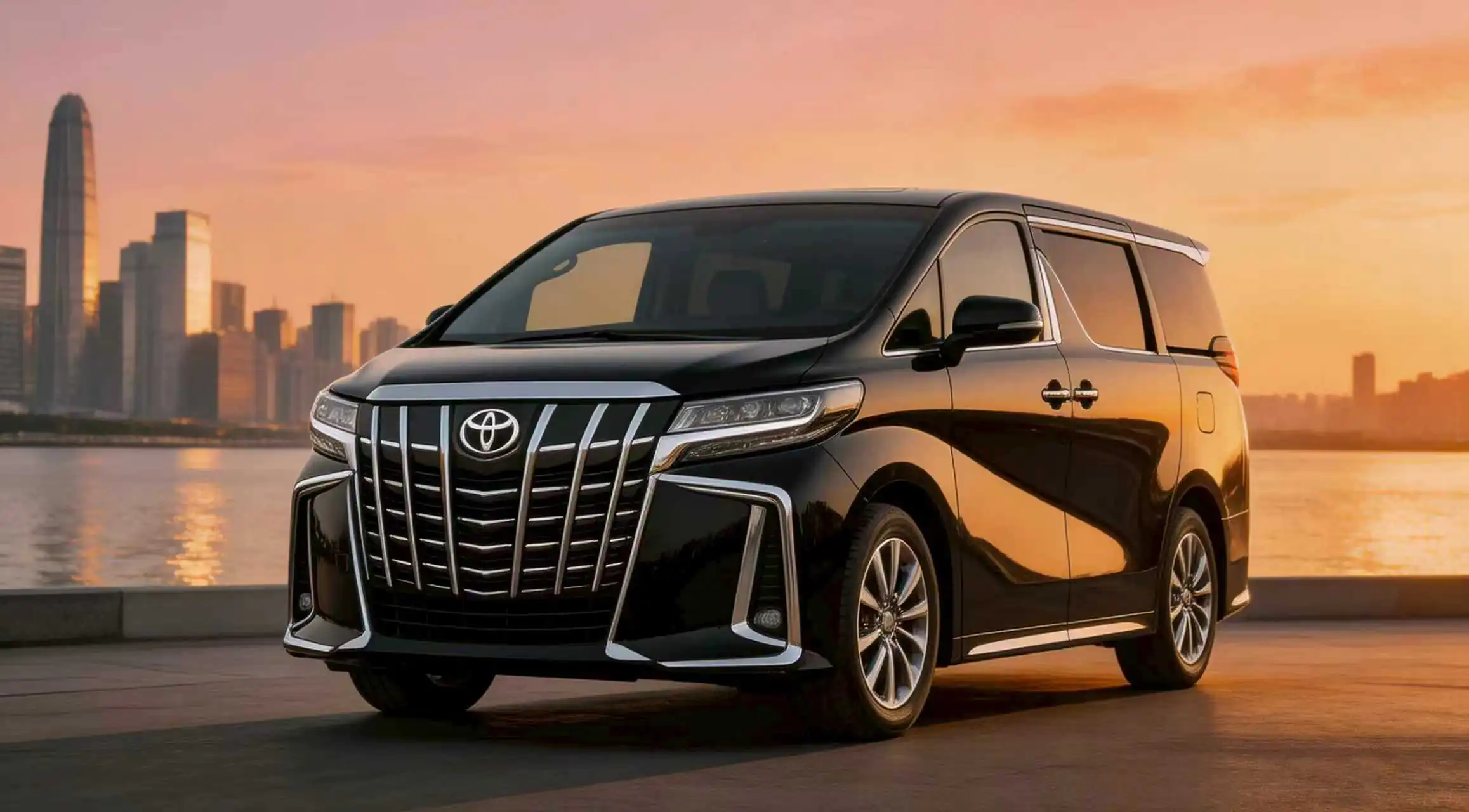
News & Updates
Inside a Cross-Border Car: Connectivity, Charging, a Folding Table and Water — How the Cabin Supports Mobile Work and Long Journeys

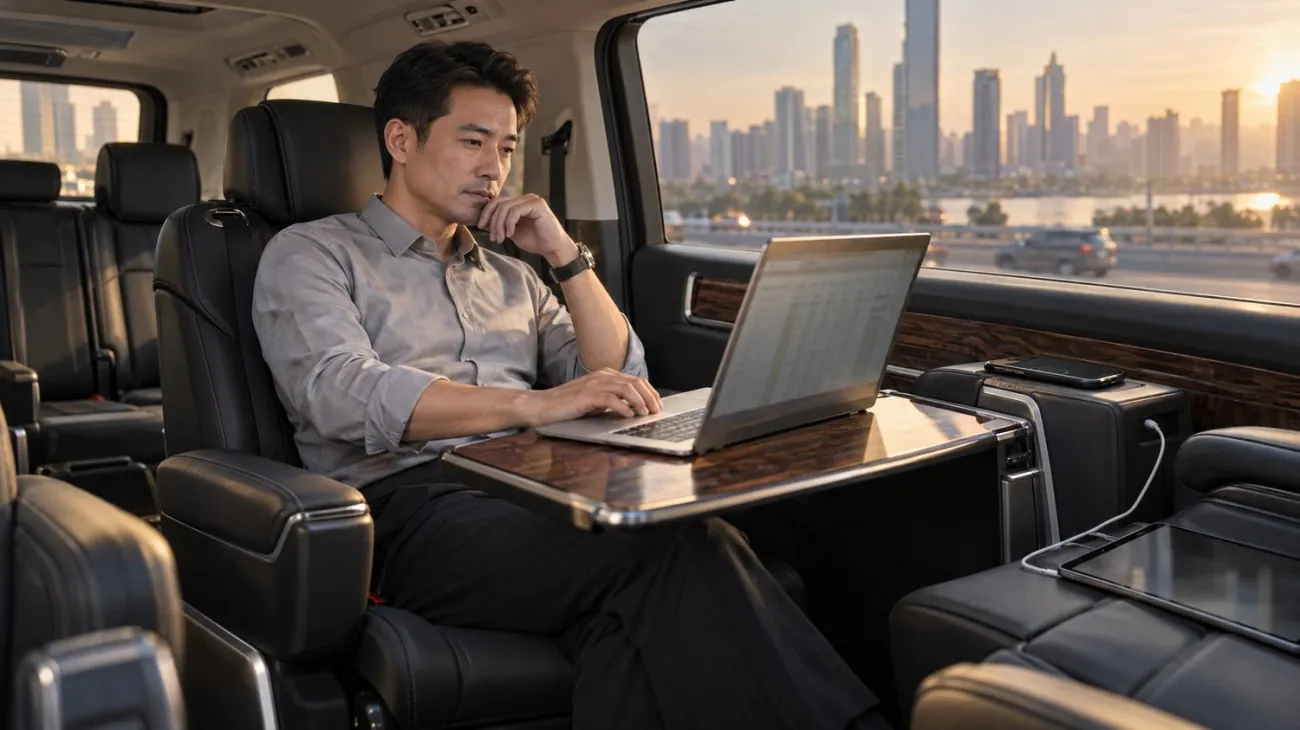
A drive from Tsim Sha Tsui to Nanshan in Shenzhen takes about an hour and fifteen minutes. For many business travellers, that is not dead time before arrival but part of the working day: answering a few emails, joining a voice call, or running through the afternoon deck one more time. Others simply want to recline the seat and arrive rested.
Cabin facilities are worth discussing in advance because the same route at the same price can offer very different working conditions depending on the vehicle. Rather than ranking models, this article breaks down what can actually be done on board: connectivity, charging, table space, lighting, drinking water and seating, along with what to mention when booking.
Figure 1. Working from the second row of a cross-border car: table, laptop and charging in use at the same time.
Power and connectivity: the two prerequisites
On board, the first problem is rarely whether the seat is comfortable. It is power and network. Phones, tablets and laptops drain faster than expected, and a cross-border trip offers few chances to recharge midway.
Charging comes down to two numbers. A USB-A port typically delivers 12 to 18 watts, enough for basic phone charging. USB-C ports commonly deliver 30, 45 or even 65 watts, which can power a tablet or some laptops. The USB PD 3.1 standard updated in 2021 raised the maximum to 240 watts, allowing more power-hungry devices to charge on the move.
| Port type | Typical output | Best suited to |
| USB-A | 12 to 18 W | Basic phone charging and small devices |
| USB-C | 30 W, 45 W, 65 W | Tablets, some laptops, power banks |
| USB PD 3.1 | Up to 240 W (depends on vehicle and device) | Devices that need high-wattage power |
Note that not every vehicle has the same number of ports, and not every port supports high wattage. If you need to charge two phones, a tablet and a laptop at the same time, state the number and type of devices when booking so the team can assign a suitable vehicle or arrange a multi-port charger.
For connectivity, there are broadly three options on board: a data service built into the vehicle, a phone hotspot from the driver or a passenger, or a dedicated in-car router.[3] An in-car router can connect several devices at once, which suits business trips that need a stable connection. A phone hotspot is convenient, but speed and battery life suffer once several devices connect. If a video call is planned, confirm the connectivity arrangement beforehand and schedule the call before entering a tunnel, since signal can drop briefly in tunnels and around border crossings.
Table, lighting and seating: what it really takes to work on board
Whether you can genuinely work in the car comes down to three small things: a stable table surface, enough light, and a seat angle that supports a long sitting position.
Many luxury MPVs offer a fold-away table in the second row. It stows without blocking access or legroom and, when deployed, holds a laptop and documents. Some converted Alphard or LM versions add a powered table, a wireless charging pad and USB or Type-C sockets.[4] Reclining angle, leg rest and headrest adjustment matter just as much, because holding one posture for a long time is more tiring than the journey itself.
Lighting is easily overlooked. Cabin reading lights usually sit in the roof and give soft light, fine for reading a document but not ideal for long sessions of dense text. Consider bringing a small lamp, or split the work into tasks you can complete on a phone. If you need to sign documents or check figures en route, say so in advance so a seat with a larger table and better lighting can be arranged.
Drinking water, temperature and light snacks
The questions that come up most on longer journeys are the small ones: is drinking water available, where are the cup holders, can the rear temperature be adjusted, and is eating on board acceptable.
Cross-border trips do not always pass a suitable rest stop, and border crossing times on public holidays are hard to predict, so having water on board saves trouble. Rear air vents and separate temperature control matter especially for older passengers and children. For food, choose light snacks that leave no smell or crumbs, and mention it when booking so the team can prepare.
Families need a different cabin from business travellers
Families ask a different set of questions: child safety seats, the step height for older passengers getting in and out, where the stroller and luggage go, and what children can do during the ride.
When three generations travel together, how the second and third rows are allocated directly affects comfort. As a rule, place the older passengers who need more assistance in the second row, secure children in a safety seat with an adult beside them, and keep luggage together at the rear so nothing shifts during the journey. Sharing the age range and mobility of everyone travelling when booking lets the team prepare seats and space before departure.
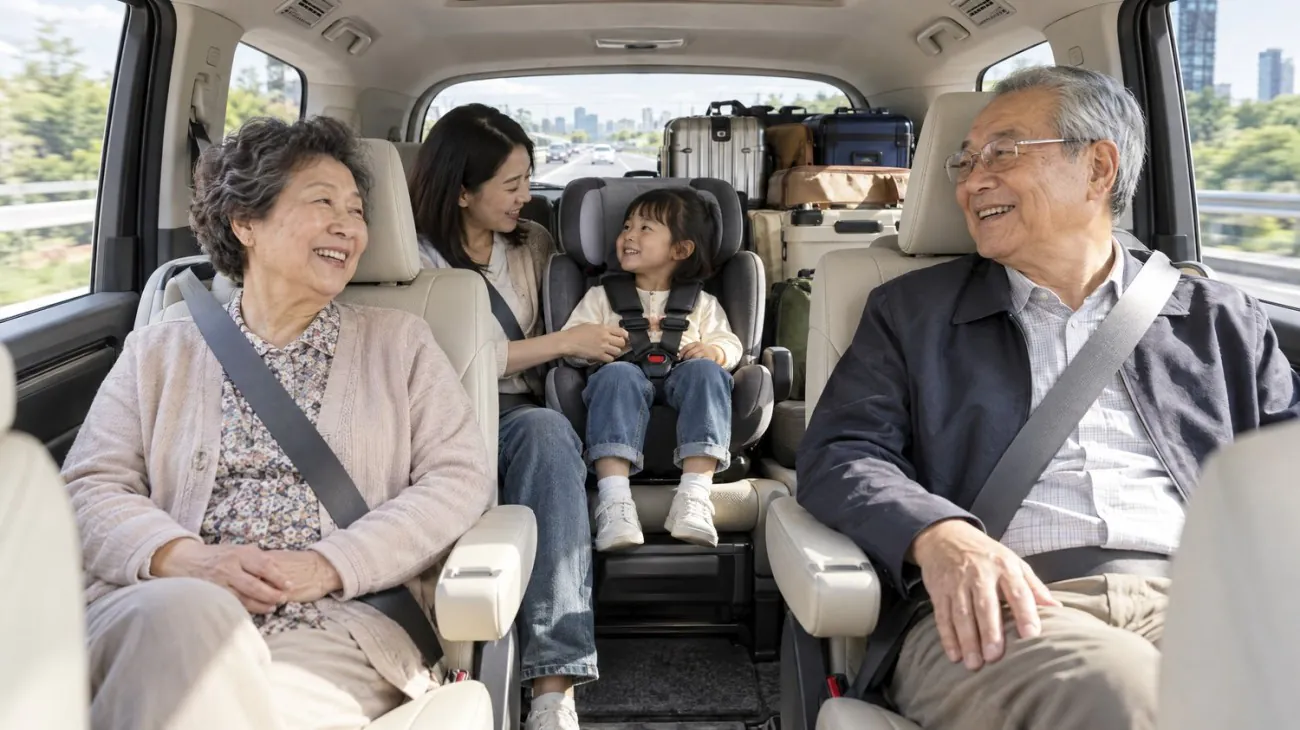
Figure 2. Three generations on board: seating for older passengers, a child safety seat and luggage kept together.
What to state when booking
| Need | What to tell us | How it affects arrangements |
| Charging | Number and type of devices (phone, tablet, laptop) | Determines whether high-wattage ports or a multi-port charger are needed |
| Connectivity | Whether a video call is needed and roughly how long | Affects the connectivity option and call timing |
| Working | Whether a table is needed and whether documents must be handled | Affects vehicle and seat configuration |
| Water | Number of passengers, whether hot water or a specific drink is needed | Affects onboard provisions |
| Family | Children's ages, whether a safety seat is needed, mobility of older passengers | Affects seating and boarding arrangements |
Common misconceptions
Some assume a luxury car must have Wi-Fi. In practice, connectivity may come from a vehicle data service, a phone hotspot or an in-car router, so it is worth confirming beforehand. Others focus on the number of ports, but port count and output wattage matter equally: one high-wattage port is often more useful than three low-wattage ones.
As for the assumption that you can always take a call, video meetings demand a stable connection, and tunnels and border areas will always introduce variables, so important calls deserve buffer time. Finally, drinking water and other provisions are not automatic in every service. Stating the need in advance is far easier than raising it after boarding.
Set out your requirements in one go and the team can prepare the vehicle and provisions before departure. Tiger Limo provides point-to-point transfers between Hong Kong, Shenzhen, Guangzhou, Macau and other Greater Bay Area cities, and can recommend a suitable arrangement with the Toyota Alphard or Mercedes-Benz V-Class for business trips that need to be productive on board, as well as for three-generation family travel.
References
[1] iniushop: Ultimate guide to car chargers — https://iniushop.com/zh/blogs/blog/ultimate-car-charger-guide-fast-charging
[2] OneMore: Understanding USB PD 3.1 — https://www.onemore.me/pages/pd31
[3] MovingComm: In-car routers for mobile internet — https://m.movingcomm.cn/news/car-mounted-wifi.html
[4] Toyota Alphard cabin specification (second-row seats, charging sockets and air vents) — https://autos.yahoo.com.tw/news/5-3-3157--54toyota-062906405.html